Comparison of Shear Bond and Failure Type on a Non-noble Metal Alloy Cast
Introduction: This in vitro study compared the shear bond strength and failure type produced by three surface treatments on a non-noble metal alloy cast.
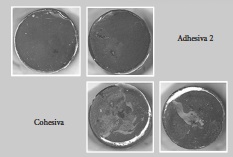
Materials and methods: Ninety six cylinders cast in a non-noble metal alloy (Argeloy® N.P. Star, Argen®), grouped in pairs for 48 double specimens in total received three different surface treatments: no sandblasting control (group 1); sandblasting with 110-μm Al2O3 (group 2) and sandblasting with 50-μm Al2O3, (group 3). Each group was divided in two subgroups to be bound with two different resin based luting cements and metal conditioners (Monobond® Plus + Multilink® N, Ivoclar Vivadent®-ml; and Metal Primer ii + gcem, gc Corporation (gc). All specimens were aged in distilled water at a constant 37°C for 8 weeks and tested for shear bond strength. Failure type was examined by stereomicroscopy.
Results: The mean shear bond strengths (in MPa) after aging were 11.02 (control gc), 9.52 (control ml), 10.08 (50 gc), 11.72 (50 ml), 7.85 (110 gc), 8.12 (110 ml). There was a statistically significant difference among groups. The lower shear bond strength was for the group that was sandblasted with 110-μm Al2O3 for both cements.
Conclusion: In the metal to metal bonding protocol sandblasting is not required.
How to Cite
License
Every single author of the articles has to declare that is an original unpublished work exclusively created by them, that it has not been submitted for simultaneous evaluation by another publication and that there is no impediment of any kind for concession of the rights provided for in the contract.
In this sense, the authors committed to await the result of the evaluation by the journal Revista Nacional de Odontologia before considering its submission to another medium; in case the response by that publication is positive, additionally, the authors committed to respond for any action involving claims, plagiarism or any other kind of claim that could be made by third parties.
At the same time, the authors have to declare that they are completely in agreement with the conditions presented in their work and that they cede all patrimonial rights. These rights involve reproduction, public communication, distribution, dissemination, transformation, making it available and all forms of exploitation of the work using any medium or procedure, during the term of the legal protection of the work and in every country in the world, to the Universidad Cooperativa de Colombia Press.
Watanabe I, Kurtz KS, Kabcenell JK, Okabe T. Effect of sandblasting and silicoating on bond strength of polymer-glass composite to cast titanium. J Prosthet Dent. 1999; 82: 462-7.
Asgar K. Casting metals in dentistry: past-present-future. Adv Dent Res. 1988; 2(1): 33-43.
Ahmad S, Omar M, Homa D. Elements released from dental casting alloys and their cytotoxic effects. Int J Prosthodont. 2002; 15(5): 473-8.
Freitas A, Francisconi P. Effect of a metal primer on the bond strength of the metal-resin interface. J Appl Oral Sci. 2004; 12(2): 113-6.
Asgar K, Peyton F. Effect of microstructure on the physical properties of cobalt-base alloys. J Dent Res. 1961; 4(1): 63-72.
Watanebe F. In vitro Bonding of Prosthodontic Adhesives to Dental Alloys. J Dent Res. 1988; 67(2): 479-83.
Petridis H, Garefis P. Bonding Indirec Resin Composites to metal: Part 2. Effect of Alloy Surface Treatment on Elemental Composition of Alloy and Bond Stregth. Int J Prosthodont. 2004; 17(1): 77-84.
Sarafianou A, Seimenis I, Papadopoulos T. Effectiveness of different adhesive primers on the bond strength between an indirect composite resin and a base metal alloy. J Prosthet Dent. 2008; 99(5): 377-86.
Janda R. Spark erosion as a metal – resin bonding system. Dent Mat. 2007; 23: 193-7.
Xie H, Yuan X, Wu F. Effects of surface treatments on bond strength between porcelain and electroformed gold substrates. J Adhes Dent. 2009; 11: 485-91.
Almilhatti H. Giampaolo E, Vergani C, Machado A, Pavarina A, Goncalves E. Adhesive bonding of resin composite to various Ni-Cr alloy surfaces using different metal conditioners and a surface modification system. J Prosthodont. 2009; 18: 663-9.
Güler A, Bek B, Koprulu H, Güler E. Shear bond strength between base metal alloy and restorative materials cemented with adhesive resin: effect of base metal surface treatment and restorative material. Hacettepe Dişhekimliği Fakültesi Dergisi. 2005; 29(2): 8-15.
Phillips RW. Skinner's science of dental materials. Philadelphia: Saunders; 1982.
Yanagida H, Matsumura H, Taira Y, Atsuta M, Shimoe S. Adhesive bonding of composite material to cast titanium with varying surface preparations. J Oral Rehabil. 2002; 29: 121-6.
Troncoso D, Rico D, Lozada H. Comparación de adaptación marginal de dos sistemas libres de metal Inceram y Empress ii en preparaciones para corona completa. Fundación cieo; 2005.
Amaral F, Colucci V, Palma R, Corona S. Assesment on in vitro methods to promote adhesive interface degradation: acritical review. J Esthet Restor Dent. 2007; 19: 340-54.
Roberti L, Rego L, Mundim F, Panzeri F, Consani S. Influence of artificial accelerated aging on dimensional stability of acrylic resins submitted to different storage protocols. J Prosthodont. 2010; 19: 432-7.
Nikaido T, Kunzelmann KH, Chen H. Evaluation of thermal cycling and mechanical loading on bond strength of a self-.etching primer system to dentin. Dent Mater. 2002; 18: 269-75.