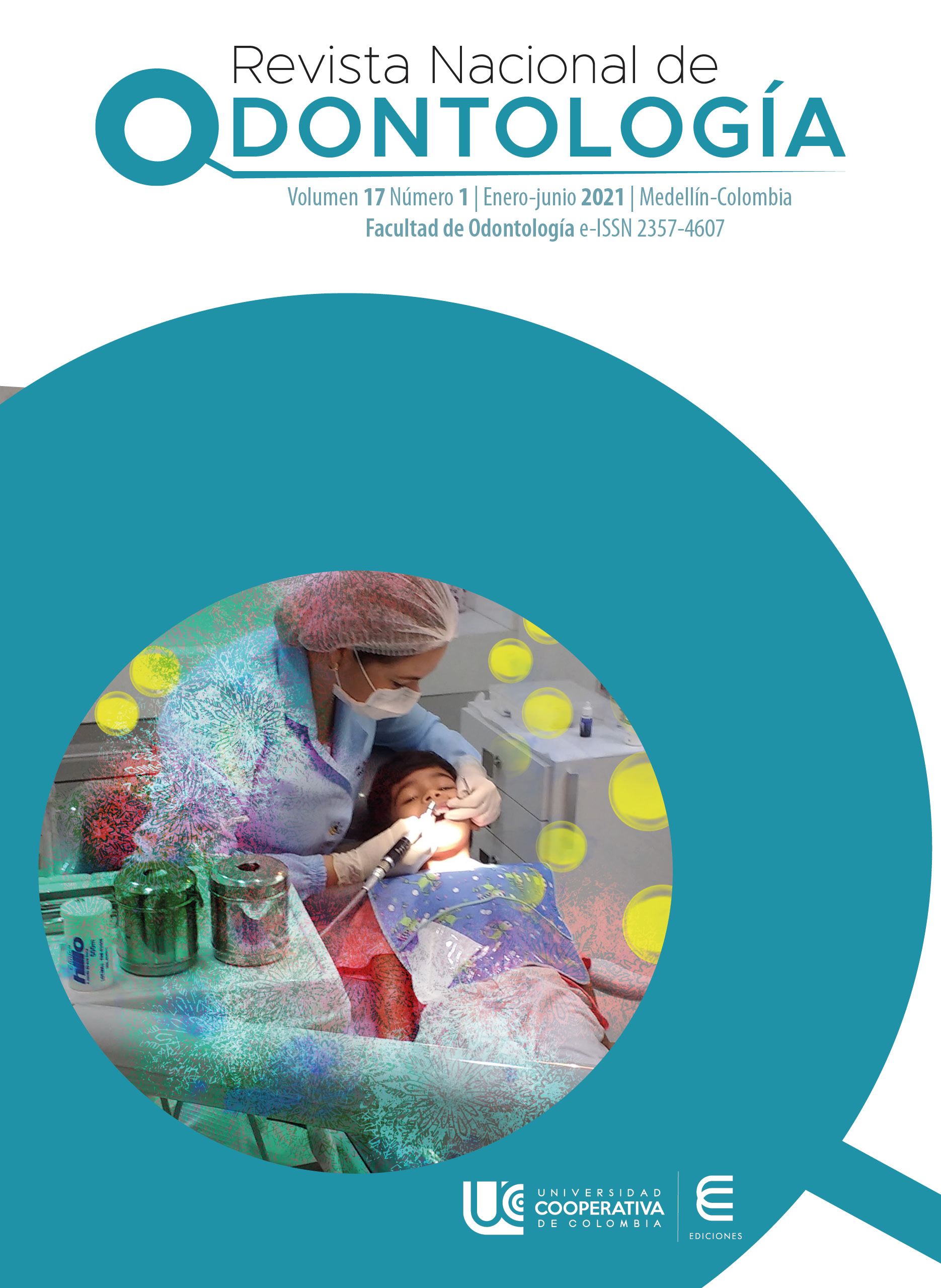
Evaluation of the presence of pathogenic bacteria in aerosols generated by high-speed parts
Introduction: The identification of pathogenic bacteria generated by the aerosols of the high parts is important because it allows to know the dental work environment, the disinfection processes and the risks to which the dental staff is exposed.
Objective: Determine the presence of pathogenic bacteria in aerosols generated by high-speed handpieces in a dental clinic.
Methods: Descriptive cross-sectional study in which the presence of pathogenic bacteria generated by high-speed handpieces was evaluated. 42 randomly selected dental units were evaluated, which were being used in clinical aerosol generating activities. The plate sedimentation technique was used for the microbiological study of the environment.
Results: In the operating procedures, growth was observed in 31.0%, followed by prophylaxis in 11.9% (5) and endodontics in 9.5% (4). In the analyzed samples, gram positive bacteria predominated: Staphylococcus sp in 40.7% (11), Streptococcus sp in 11.1% (3), gram positive bacilli in 25.9% (7) and Micrococcus sp with 3.7% (1).
Conclusion: The high part increases the amount of aerosols during the operating procedures, followed by prophylaxis. The bacteria that were found in greater quantity correspond to gram positive cocci type Staphylococci sp. However, the quality conditions of the clinic are adequate, it is important to continue strengthening all the processes and procedures that lead to the provision of the service under biosafety parameters.
How to Cite
License
Copyright (c) 2021 Revista Nacional de Odontología

This work is licensed under a Creative Commons Attribution 4.0 International License.
Every single author of the articles has to declare that is an original unpublished work exclusively created by them, that it has not been submitted for simultaneous evaluation by another publication and that there is no impediment of any kind for concession of the rights provided for in the contract.
In this sense, the authors committed to await the result of the evaluation by the journal Revista Nacional de Odontologia before considering its submission to another medium; in case the response by that publication is positive, additionally, the authors committed to respond for any action involving claims, plagiarism or any other kind of claim that could be made by third parties.
At the same time, the authors have to declare that they are completely in agreement with the conditions presented in their work and that they cede all patrimonial rights. These rights involve reproduction, public communication, distribution, dissemination, transformation, making it available and all forms of exploitation of the work using any medium or procedure, during the term of the legal protection of the work and in every country in the world, to the Universidad Cooperativa de Colombia Press.
Veena HR, Mahantesha S, Preethi A. J, Sudhir R, P, Suvarna H. P. Dissemination of aerosol and splatter during ultrasonic scaling: A pilot study. Journal of Infection and Public Health. 2015; 8:260-265. doi: https://doi.org/10.1016/j.jiph.2014.11.004.
Bentley CD, Burkhart NW, Crawford JJ. Evaluación de salpicaduras y contaminación de aerosoles durante procedimientos dentales. The Journal of the American Dental Association.1994;125(5):579–584.doi: https://doi.org/10.14219/jada.archive.1994.0093.
Harrel SK, Barnes JB, Rivera-Hidalgo F. Aerosol and splatter contamination from the oper-ative site during ultrasonic scaling. J Am Dent Assoc. 1998; 129(9):1241-9. doi: https://doi.org/10.14219/jada.archive.1998.0421
Kobza, JS Pastuszka, E Brągoszewska. ¿Las exposiciones a aerosoles representan un riesgo para los profesionales de la odontología? Medicina ocupacional. 2018; 68(7):454–458. doi: https://doi.org/10.1093/occmed/ kqy095
Checchi L, Montevecchi M, Moreschi A, Graziosi F, Taddei P, Violante FS. Efficacy of three face masks in preventing inhalation of airborne contaminants in dental practice. The Journal of the American Dental Association. 2005; 136(7):877–882.doi: https://doi.org/10.14219/jada.archive.2005.0288.
Sawhney A, Venugopal S, Babu GR, Garg A, Mathew M, Yadav M, Gupta B, Tripathi S. Aerosols How Dangerous They Are in Clinical Practice. Journal of Clinical and Diagnostic Research. 2015; 9(4): ZC52-ZC57J. doi: https://doi.org/10.7860/JCDR/2015/12038.5835.
Bernard Polednik. Aerosol and bioaerosol particles in a dental office. Environmental Research. 2014; (134):405-409. doi: https://dx.doi.org/10.1016/j.envires.2014.03.027.
Freeman J. Risk of aerosol contamination around the dental chair. Dental Nursing. 2013; 9(1):12-5. doi: https://doi.org/10.12968/denn.2013.9.1.12.
Montebugnoli L, Chersoni S, Prati C, Dolci G. A between-patient disinfection method to control water line contamination and biofilm inside dental units. Journal of Hospital Infection. 2204; 56(4):297–304. doi: https://doi.org/10.1016/j.jhin.2004.01.015.
Kedjarune U, Kukiattrakoon B, Yapong B, Chowanadisai S, Leggat PA. Bacterial aerosols in the dental clinic: effect of time, position and type of treatment. International Dental Journal. 2000; 50(2):103–107. doi: https://doi.org/10.1002/j.1875-595x.2000.tb00807.x
Yi Yi Yong, Gary D, Wee Sim C. Biofilm formation by staphylococci in health-related envi-ronments and recent reports on their control using natural compounds. Critical Reviews in Microbiology. 2019; 45(2): 201-222. doi: https://doi.org/10.1080/1040841X.2019.1573802.
Rautemaa R, Nordberg A, Wuolijoki-Saaristo K, Meurman JH. Bacterial aerosols in dental practice–a potential hospital infection problem? J Hosp Infect. 2006; 64:76–81. doi: https://doi.org/10.1016/j.jhin.2006.04.011.
Maya JJ, Ruiz SJ, Pacheco R, Valderrama SL, Villegas MV. Role of chlorhexidine in the preven-tion of health care related infections. Infectio. 2011; 5(2):98-107.