Analysis of Slope Instability Processes Through Comparison of Limit Equilibrium and Finite Element Methods
Introduction: The article presents research results on the analysis of slope instability processes, conducted at the Universidad Pedagógica y Tecnológica de Colombia in 2019.
Problem: Slope instability processes are permanently present in the state of Boyacá – Colombia. The stability analysis through the application of conventional limit equilibrium methods does not reflect the real conditions of mechanical resistance of the materials found.
Aim: Analyze slope instability processes utilizing the finite element method in two critical spots located on the road that connects the city of Tunja with the town of Miraflores.
Methods: Start with the search and compilation of information from critical spots with relevant geotechnical characterization on roads in the state, thereby permitting the identification of two unstable critical spots. With the use of geological, geotechnical and hydrological information, the mechanical behavior of the materials is modelled through the software Slide and Midas GTS NX.
Results: The estimation of material stability through the finite element method shows more reliable results compared to the actual behavior of the studied locations and compared to the methods based on limit equilibrium.
Conclusion:The use of this numerical simulation technique is recommended to replace conventional methods, being an affordable and effective tool for the analysis of instability processes.
Originality: Most analyses of instability processes conducted in the state of Boyacá – Colombiado not use the finite element method.
Limitations: The estimation of material stability is based on a constitutive model for soil and another for rock.
How to Cite
License
Copyright (c) 2020 Ingeniería Solidaria

This work is licensed under a Creative Commons Attribution 4.0 International License.
Cession of rights and ethical commitment
As the author of the article, I declare that is an original unpublished work exclusively created by me, that it has not been submitted for simultaneous evaluation by another publication and that there is no impediment of any kind for concession of the rights provided for in this contract.
In this sense, I am committed to await the result of the evaluation by the journal Ingeniería Solidaría before considering its submission to another medium; in case the response by that publication is positive, additionally, I am committed to respond for any action involving claims, plagiarism or any other kind of claim that could be made by third parties.
At the same time, as the author or co-author, I declare that I am completely in agreement with the conditions presented in this work and that I cede all patrimonial rights, in other words, regarding reproduction, public communication, distribution, dissemination, transformation, making it available and all forms of exploitation of the work using any medium or procedure, during the term of the legal protection of the work and in every country in the world, to the Universidad Cooperativa de Colombia Press.
Unidad Nacional para la Gestión del Riesgo de Desastres de Colombia, “Plan Nacional de Gestión del Riesgo de Desastres 2015-2025,” pp. 106–107, 2016. [Online]. Available: https://repositorio.gestiondelriesgo.gov.co/bitstream/handle/20.500.11762/756/PNGRD-2016.pdf?sequence=27&isAllowed=y.
Departamento Nacional de Planeación de Colombia, “3.181 muertos y 12,3 millones de afectados: las cifras de desastres naturales entre 2006 y 2014,” pp. 1, 2015. [Online]. Available: https://www.dnp.gov.co/Paginas/3-181-muertos,-21-594-emergencias-y-12,3-millones-de-afectados-las-cifras-de-los-desastres-naturales-entre-2006-y-2014-.aspx.
D. Eckstein, M.-L. Hutfils, and W. Maik, “Global Climate Risk Index 2019,” pp. 28–35, 2018. [Online]. Available: https://www.germanwatch.org/sites/germanwatch.org/files/Global Climate Risk Index 2019_2.pdf.
O. Kjekstad and L. Highland, “Economic and Social Impacts of Landslides,” in Landslides – Disaster Risk Reduction. S. Kyoji P. and Canuti, P. (Eds). Berlin, Heidelberg: Springer Berlin Heidelberg, pp. 573–587, 2009. [Online]. doi: http://dx.doi.org/10.1007/978-3-540-69970-5_30.
M. Budhu, Soil mechanics and foundations, 3rd ed., John Wiley & Sons Inc., pp. 687–691, 2011.
D. M. Cruden, “A simple definition of a landslide,” Bull. Int. Assoc. Eng. Geol. - Bull. l’Association Int. Géologie l’Ingénieur, vol. 43, no. 1, pp. 27–29, 1991. [Online]. doi: http://dx.doi.org/10.1007/BF02590167.
D. J. Varnes, “Slope movement types and processes,” Special report 176: Landslides: Analysis and control. Schuster R.L. and Krizek, R.J. (Eds.), TRB, National Research Council, Washington, D.C., pp.11-33, 1978.
S. M. Springman, A. Thielen, P. Kienzler, and S. Friedel, “A long-term field study for the investigation of rainfall-induced landslides,” Géotechnique, vol. 63, no. 14, pp. 1177–1193, 2013. [Online]. doi: http://dx.doi.org/10.1680/geot.11.P.142.
D. Brunsden and D. B. Prior, Slope instability, pp. 1-7, 1984. [Online].doi: http://dx.doi.org/10.1002/esp.3290110214.
M. J. Crozier, Landslides: causes, consequences and environment. London: Croom Helm Australia Pty. Ltd., 1986.
S. Abuzied, S. Ibrahim, M. Kaiser, and T. Saleem, “Geospatial susceptibility mapping of earthquake-induced landslides in Nuweiba area, Gulf of Aqaba, Egypt,” J. Mt. Sci., vol. 13, no. 7, pp. 1286–1303, 2016. [Online].doi: http://dx.doi.org/10.1007/s11629-015-3441-x.
K. Sassa, “The mechanism starting liquefied landslides and debris flows,” Proc. 4th Int. Symp. Landslides, Toronto, Canada, 1984, vol. 2, pp. 349–354, 1984.
T. T. Lim, H. Rahardjo, M. F. Chang, and D. G. Fredlund, “Effect of rainfall on matric suctions in a residual soil slope,” Can. Geotech. J., vol. 33, no. 4, pp. 618–628, 1996. [Online]. doi: http://dx.doi.org/10.1139/t96-087.
R. M. Iverson, “Landslide triggering by rain infiltration,” Water Resour. Res., vol. 36, no. 7, pp. 1897–1910, 2000. [Online]. doi: http://dx.doi.org/10.1029/2000WR900090.
G. Wang and K. Sassa, “Factors affecting rainfall-induced flowslides in laboratory flume tests,” Géotechnique, vol. 51, no. 7, pp. 587–599, 2001. [Online].doi: http://dx.doi.org/10.1680/geot.2001.51.7.587.
H. Ochiai et al., “A fluidized landslide on a natural slope by artificial rainfall,” Landslides, vol. 1, no. 3, pp. 211–219, 2004. [Online]. doi: http://dx.doi.org/10.1007/s10346-004-0030-4.
Y. Matsushi and Y. Matsukura, “Rainfall thresholds for shallow landsliding derived from pressure-head monitoring: cases with permeable and impermeable bedrocks in Boso Peninsula, Japan,” Earth Surf. Process. Landforms, vol. 32, no. 9, pp. 1308–1322, 2007. [Online]. doi: http://dx.doi.org/10.1002/esp.1491.
W. Fellenius, Statens Jarnjvagars Geoteknniska Commission. Stockholm, Sweden, 1927.
R. W. Clough and Woodward R J, “Analysis of embankment stresses and deformations,” J. Soil Mech. Found. Div., vol. 93, no. 4, pp. 529–549, 1967.
Presidencia de Colombia, “Decreto 2618 por el cual se modifica la estructura del Instituto Nacional de Vías (Invías) y se determinan las funciones de sus dependencias,” pp. 1–3, 2013. [Online]. Available: http://svrpubindc.imprenta.gov.co/diario/index.xhtml;jsessionid=216929a069807099dff17784070e.
Instituto Nacional de Vías (INVIAS), “Contrato 2127 de 2011 ‘Actualización de los estudios y diseños para el mejoramiento de la carretera Tunja – Ramiriquí – Miraflores – Páez entre el PR 0 y el PR 118, ruta 60 en el Departamento de Boyacá.’” 2014.
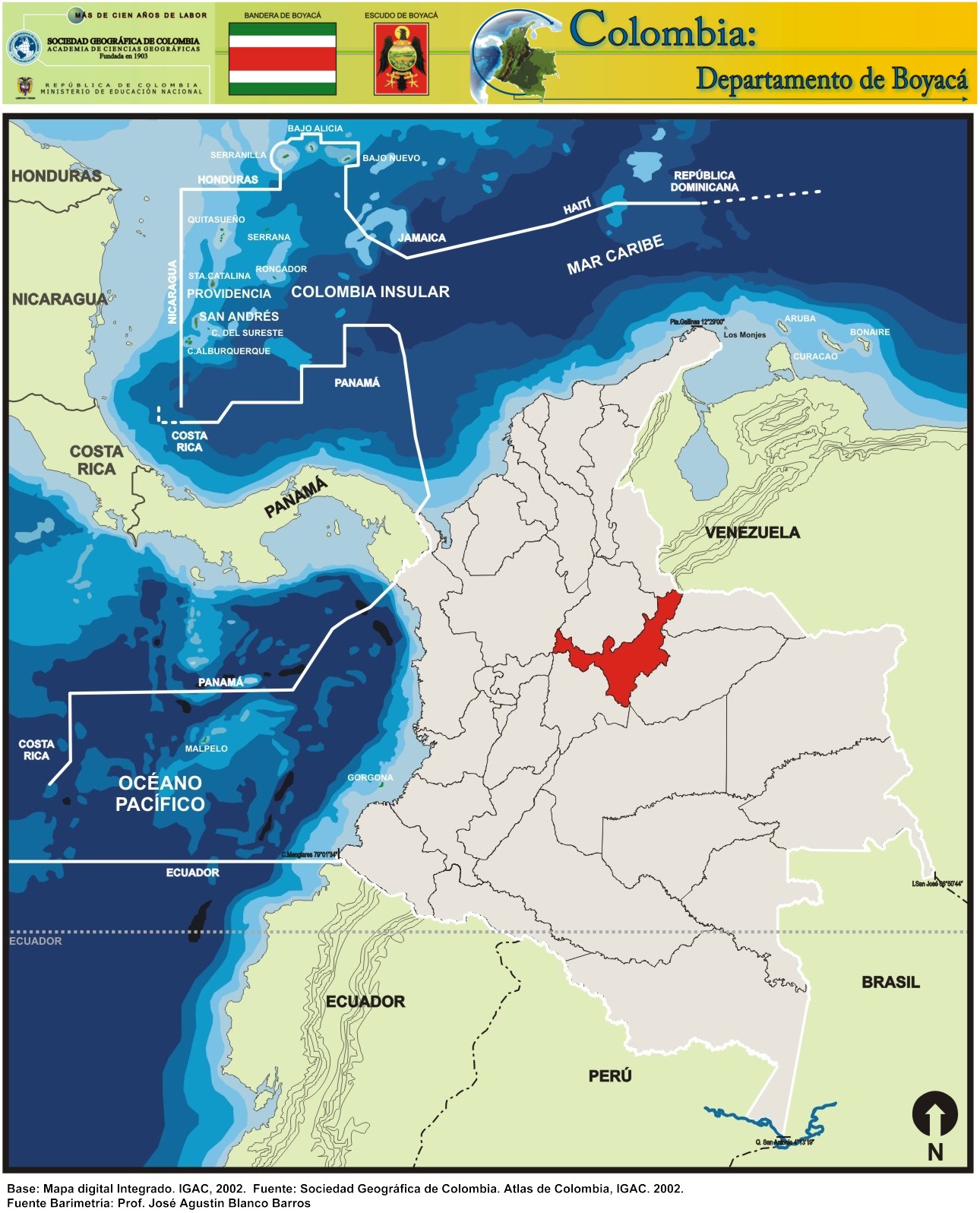
Sociedad Geográfica de Colombia, “Departamento de Boyacá,” Geografía General y de Colombia, 2002. [Online]. Available: http://sogeocol.edu.co/dptos/boyaca_02_ubicacion.jpg.
Instituto Nacional de Vías (INVIAS), “Mapa de carreteras de Boyacá,” 2018. [Online]. Available: https://www.invias.gov.co.
Departamento Administrativo de Planeación de Boyacá, “Ordenamiento Territorial Departamental de Boyacá - Dimensión Funcional: Servicios Públicos e Infraestructura,” pp. 46–50, 2017. [Online]. Available: https://dapboyaca.gov.co/wp-content/uploads/2018/09/DIMENSION-FUNCIONAL_SERVICIOS_INFRAESTRUCTURA.pdf.
Departamento Administrativo de Planeación de Boyacá, “Susceptibilidad del Departamento de Boyacá a Inundaciones y Deslizamientos,” pp. 23–26, 2011. [Online]. Available: https://www.dapboyaca.gov.co/descargas/publicaciones/susceptibilidad_inundaciones.pdf.
Instituto Nacional de Vías (INVIAS), “Mapa de carreteras de Colombia,” 2019 [Online]. Available: https://hermes.invias.gov.co/carreteras/.