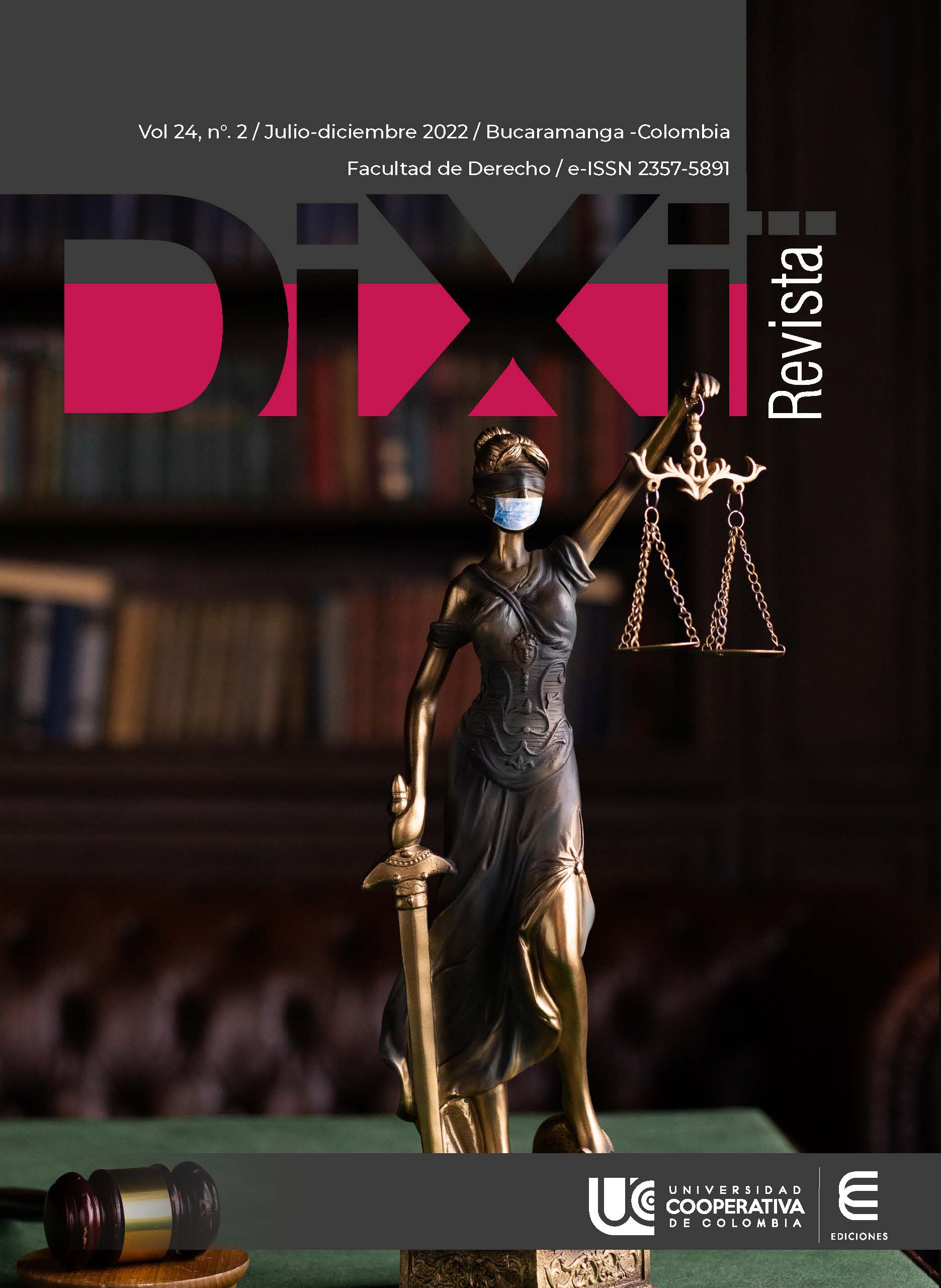
Transitional justice in Colombia challenges and perspectives. A multidisciplinary approach to restoring the social fabric
Colombia is currently undergoing a process of reconstruction of the social fabric after the armed conflict. Transitional justice emerges as a legal mechanism and an integral system for the achievement of peace, with the strengthening of civil trust and social restoration. The challenges and perspectives today seek to promote an innovative sense of nation, a new interpretation of the concept of victim and a different vision of the values of the State. The current project aims to interpret the victim as a transforming subject, founder of coexistence strategies and direct participant in actions that materialize real practices of truth, justice and reparation. With a qualitative and multidisciplinary approach, social mapping is applied to obtain data that will allow a systematic analysis of the perspectives and scope of transitional justice from the perspectives of philosophy, anthropolo-gy, sociology, psychology, education and economics. The aim is to establish the historical responsibility of the communities in the reconstruction of the social fabric, and to reinterpret and assume effective commitments to resilience of the population of victims in Barrancabermeja, Yondó and Cantagallo. It is expected that the results will impact the victims in a new reading, involving them proactively and legitimately in their own restoration, with repercussions for the recovery of human capital in the three territories under study.
How to Cite
License
Copyright (c) 2022 DIXI

This work is licensed under a Creative Commons Attribution 4.0 International License.
Every single author of the articles has to declare that is an original unpublished work exclusively created by them, that it has not been submitted for simultaneous evaluation by another publication and that there is no impediment of any kind for concession of the rights provided for in the contract.
In this sense, the authors committed to await the result of the evaluation by the journal DIXI before considering its submission to another medium; in case the response by that publication is positive, additionally, the authors committed to respond for any action involving claims, plagiarism or any other kind of claim that could be made by third parties.
At the same time, the authors have to declare that they are completely in agreement with the conditions presented in their work and that they cede all patrimonial rights. These rights involve reproduction, public communication, distribution, dissemination, transformation, making it available and all forms of exploitation of the work using any medium or procedure, during the term of the legal protection of the work and in every country in the world, to the Universidad Cooperativa de Colombia Press.
Carolina Rodríguez Rodríguez. Postconflicto y justicia transicional en Colombia: balance de nuestra experiencia. HALLAZGOS 15. 2011. Pág. 137-159. Disponible en: https://doi.org/10.15332/s1794-3841.2011.0015.07
Corte Constitucional de Colombia. SENTENCIA C-250/12. (M.P. Humberto Antonio Sierra Porto; marzo 23 de 2012). Disponible en: https://www.corteconstitucional.gov.co/relatoria/2012/C-250-12.htm
Corte Constitucional de Colombia. SENTENCIA C-280/13. (M.P. Nilson Pinilla Pinilla; mayo 15 de 2013). Disponible en: https://www.corteconstitucional.gov.co/relatoria/2013/C-280-13.htm
Corte Constitucional de Colombia. SENTENCIA T-092/19. (M.P. Gloria Stella Ortiz Delgado; marzo 4 de 2019). Disponible en: https://www.corteconstitucional.gov.co/relatoria/2019/t-092-19.htm
Cristhian Fernando Sánchez Giraldo y Dulfary Calderón Sánchez (2017). Geopolítica de los derechos humanos en las fronteras terrestres de Colombia en el primer periodo presidencial de Juan Manuel Santos. VIEI 2. Julio-diciembre 2017. Pág. 53-72. Disponible en: https://doi.org/10.15332/s1909-0528.2017.0002.03
Elsy Domínguez De la Ossa y José D. Herrera González (2013). La investigación narrativa en psicología: definición y funciones. PSICOLOGÍA DESDE EL CARIBE. UNIVERSIDAD DEL NORTE 3, 2013. Pág. 620-641.
Gregorio Rodríguez Gómez, Javier Gil Flores y Eduardo García Jiménez. INTRODUCCIÓN A LA INVESTIGACIÓN CUALITATIVA. Ediciones Aljibe. (1996). Disponible en: https://cesaraguilar.weebly.com/uploads/2/7/7/5/2775690/rodriguez_gil_01.pdf
International Center for Transitional Justice (ICTJ). MECANISMOS DE JUSTICIA TRANSICIONAL EN COLOMBIA. ICTJ. Disponible en: https://www.ictj.org/sites/default/files/subsites/colombia-linea-tiempo/index.html
Kai Ambos, Ezequiel Malarino y Gisela Elsner. JUSTICIA DE TRANSICIÓN. Konrad Adenauer Stiftung. (2009).
Keough School of Global Affairs. Instituto Kroc publica sexto informe sobre implementación del Acuerdo de Paz en Colombia. Sala de Prensa. Junio 8 de 2022. Disponible en: https://keough.nd.edu/es/instituto-kroc-publica-sexto-informe-sobre-implementacion-del-acuerdo-de-paz-en-colombia/
Luis Germán Ortega-Ruiz y Juan Pablo García-Miranda. La verdad en la justicia transicional. IUSTA 50. 2018. Pág. 39-63. Disponible en: https://doi.org/10.15332/1900-0448.2019.0050.02
Laura Loeza Reyes. Visibilizando a las víctimas: entre el paradigma seguritista y el paradigma de los derechos humanos. INTERDISCIPLINA 20. Pág. 133-152. Disponible en: https://doi.org/10.22201/ceiich.24485705e.2020.20.71976
Luis Botella García del Cid. La cartografía de los espacios psicológicos: aplicaciones psicoterapéuticas de las dinámicas sistémicas de mapas cognitivos borrosos de constructos personales. REVISTA DE PSICOTERAPIA 118. 2021. Disponible en: https://doi.org/10.33898/rdp.v32i118.474
Rafael Grasa. COLOMBIA CUATRO AÑOS DESPUÉS DE LOS ACUERDOS DE PAZ: UN ANÁLISIS PROSPECTIVO. Documentos de Trabajo N.° 39. Fundación Carolina. (2020). Disponible en: https://www.fundacioncarolina.es/wp-content/uploads/2020/12/DT_FC_39.pdf
Ricardo Sebastián Piana. Revisitando el concepto de estado en Carl Schmitt. Legalidad, legitimidad y derecho. JURÍDICAS CUC 1. 2019. Pág. 9-38. https://doi.org/10.17981/juridcuc.16.1.2020.01
Rodrigo Uprimny Yepes y Diana Isabel Güiza Gómez. Pacigerancia: el valor jurídico de los acuerdos de paz en el derecho internacional. Latin American Law Review 3. 2019. Pág. 49-78. https://doi.org/10.29263/lar03.2019.03
William Alejandro Gamboa Sierra, María Fernanda Loaiza Álvarez y Julián Emiro Roa Triana. MEMORIA HISTÓRICA Y PATRIMONIO CULTURAL: SU CONTRIBUCIÓN A LA RESTAURACIÓN DEL TEJIDO SOCIAL, EN UN ESCENARIO DE POST CONFLICTO EN COLOMBIA. Editorial Universidad Externado de Colombia. (2015).