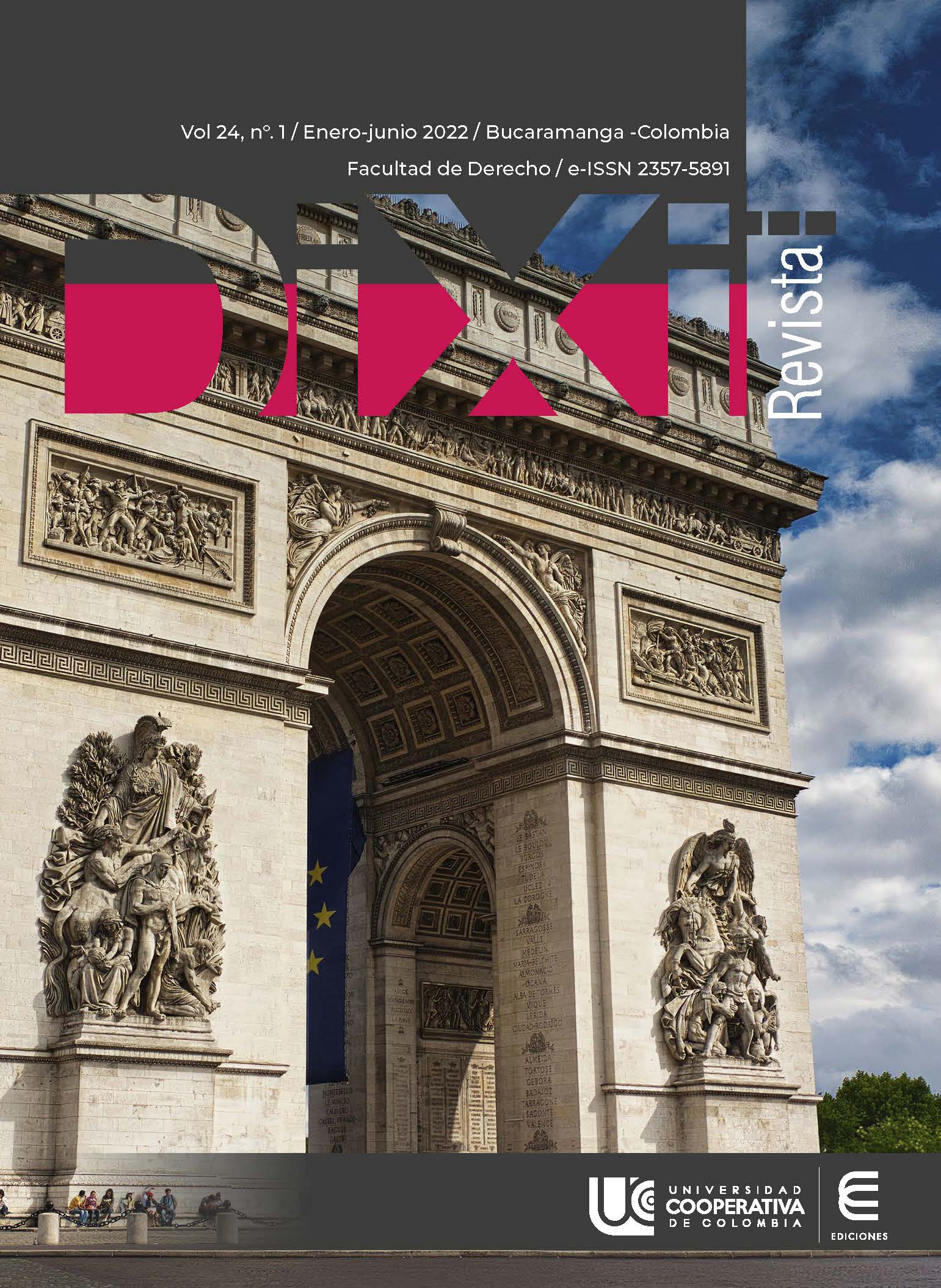
Wild animals and constitutional procedural law
Introduction: In Colombia, constitutional procedural law and the actions contemplated in the Political Constitution, especially habeas corpus, the popular action and the tutela action, have a marked anthropocentric destination, which makes their use in favor of other animal species inoperative.
Methodology: Through a descriptive documentary analysis, the nature of constitutional procedural law and its incidence on the protection of wild animals in Colombia is investigated, reviewing jurisprudence and analyzing sources.
Findings: Although progress has been made in laws that impact animal protection, the protection and conservation of animal species, via jurisdictional means, will be nugatory as long as new actions are not created exclusively in favor of non-human animals (recognizing a new specialty such as animal law), or as long as the general interest of the animal is rewarded over the formalism of constitutional procedural law.
Conclusions: The Constitutional Court, in Unification Ruling 016 of January 2020, determined that habeas corpus is only appropriate for the protection of the fundamental right to freedom of persons, and it is not possible to use it in the case of non-human animals. The protection and conservation of animals constitutes a collective right in accordance with articles 8, 79, 80, 88, 95-8 of the Political Constitution for which a popular action is appropriate. However, the dependence of “animal law” on other specialties of law, in the precise case of “constitutional procedural” law, has caused obstacles in the real and effective protection of wild animal species in Colombia.
How to Cite
License
Copyright (c) 2021 DIXI

This work is licensed under a Creative Commons Attribution 4.0 International License.
Every single author of the articles has to declare that is an original unpublished work exclusively created by them, that it has not been submitted for simultaneous evaluation by another publication and that there is no impediment of any kind for concession of the rights provided for in the contract.
In this sense, the authors committed to await the result of the evaluation by the journal DIXI before considering its submission to another medium; in case the response by that publication is positive, additionally, the authors committed to respond for any action involving claims, plagiarism or any other kind of claim that could be made by third parties.
At the same time, the authors have to declare that they are completely in agreement with the conditions presented in their work and that they cede all patrimonial rights. These rights involve reproduction, public communication, distribution, dissemination, transformation, making it available and all forms of exploitation of the work using any medium or procedure, during the term of the legal protection of the work and in every country in the world, to the Universidad Cooperativa de Colombia Press.
Congreso de la República. Ley 99 de 1993. Por la cual se crea el Ministerio del Medio Ambiente, se reordena el Sector Público encargado de la gestión y conservación del medio ambiente y los recursos naturales renovables, se organiza el Sistema Nacional Ambiental, SINA, y se dictan otras disposiciones. Diciembre 22 de 1993. DO N.° 41.146.
Congreso de la República. Ley 1638 de 2013. Por medio de la cual se prohíbe el uso de animales silvestres, ya sean nativos o exóticos, en circos fijos e itinerantes. Junio 27 de 2013. DO N.° 48.834.
Congreso de la República. Ley 1774 de 2016. Por medio de la cual se modifican el Código Civil, la Ley 84 de 1989, el Código Penal, el Código de Procedimiento Penal y se dictan otras disposiciones. Enero 6 de 2016. DO N.° 39.120.
Congreso de la República. Ley 1801 de 2016. Por la cual se expide el Código Nacional de Seguridad y Convivencia Ciudadana. Julio 29 de 2016. DO N.° 49.949.
Consejo de Estado, Sala de lo Contencioso Administrativo. SENTENCIA 1999-0909 DE 2012. (M.P. Enrique Gil Botero; mayo 23 de 2012).
Consejo de Estado, Sala de lo Contencioso Administrativo. SENTENCIA 2011-00227 DE 2013. (M.P. Enrique Gil Botero; noviembre 26 de 2013).
Consejo de Estado, Sala de lo Contencioso Administrativo. SENTENCIA 2014-00723 DE 2014. (M.P. Carmen Teresa Ortiz de Rodríguez; diciembre 12 de 2014).
Corte Constitucional de Colombia. SENTENCIA SU-016 DE 2020. (M.P. Luis Guillermo Guerrero Pérez; enero 23 de 2020).
Diego Lopéz Medina. EL CAMBIO DOGMÁTICO-JURÍDICO COMO RESPUESTA AL CAMBIO SOCIAL: LA LABOR DEL CONSEJO DE ESTADO Y DE LA CORTE CONSTITUCIONAL EN LA RECONSIDERACIÓN DEL ESTATUTO JURÍDICO DE LOS ANIMALES EN COLOMBIA. Editorial Universidad Externado. (2015).
Jaime Orlando Santofimio Gamboa. ACCIONES POPULARES Y MEDIDAS CAUTELARES EN DEFENSA DE LOS DERECHOS E INTERESES COLECTIVOS: UN PASO EN LA CONSOLIDACIÓN DEL ESTADO SOCIAL DE DERECHO. Editorial Universidad Externado. (2010).
Juan Carlos Guayacán. La selección de sentencias para la unificación de la jurisprudencia. Tres historias paralelas entre la Corte Constitucional, el Consejo de Estado y la Sala de Casación Civil de la Corte Suprema de Justicia. REVISTA DE DERECHO PRIVADO 19. Diciembre de 2020. Pág. 57-79.
Lucelly Rocío de las Mercedes Munar Castellanos y Luis Roberto Ortiz. DERECHO PROCESAL ADMINISTRATIVO Y DE LO CONTENCIOSO ADMINISTRATIVO. Temis. (2014).
Luz Marcela Pérez Arias y Milton Dubán Monsalve Mantilla. Maltrato animal en Colombia: protección penal y contravencional en favor de los animales. DIXI 32. 2020. Pág. 1-16. Disponible en: https://doi.org/10.16925/2357-5891.2020.02.07
Manuel Fernando Quinche Ramírez. DERECHO PROCESAL CONSTITUCIONAL COLOMBIANO. ACCIONES Y PROCESOS. Ediciones Doctrina y Ley. (2015).
María Cristina Patiño González. El habeas corpus. REVISTA DERECHO DEL ESTADO 8. Junio de 2000. Pág. 127-158.
Martha Nussbaum. LAS FRONTERAS DE LA JUSTICIA: CONSIDERACIONES SOBRE LA EXCLUSIÓN. Paidós. (2006).
Óscar Darío Amaya Navas. LA CONSTITUCIÓN ECOLÓGICA DE COLOMBIA. Editorial Universidad Externado de Colombia. (2010).
Pablo Dermizaky Peredo. El derecho proceso constitucional. REVISTA BOLIVIANA DE DERECHO 4. 2007. Pág. 1-20.
Presidencia de la República. Decreto Ley 2811 de 1974. Por el cual se dicta el Código Nacional de Recursos Naturales Renovables y de Protección al Medio Ambiente Diciembre 18 de 2019. DO N.° 34.243.