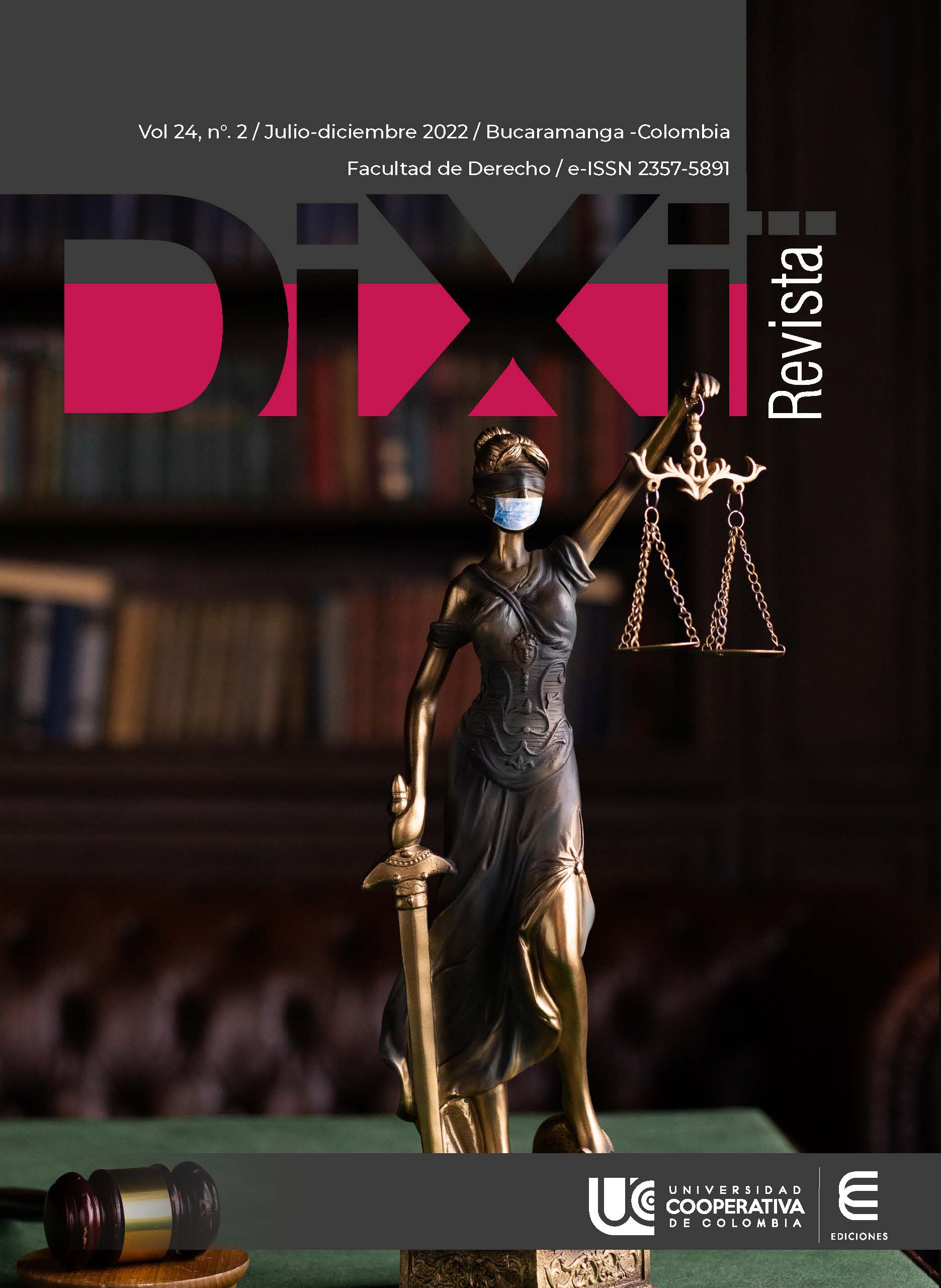
Exercising the right to social protest as a mechanism for the defense of human rights analysis of the Colombian socio-legal context in times of pandemic
In Colombia, as of April 28, 2021, multiple demonstrations and social protests have been carried out in defense of human rights, in opposition to the tax reform and different actions of the State. In the context of these events, it is necessary to analyze the socio-legal context of the exercise of the right to social protest as a mechanism of defense and guarantee of protection of other human rights, during the covid-19 pandemic, since these spaces generate social agglomeration, which has been considered a risk factor in the face of the public health crisis. Based on the above, this article presents as a result an analysis of the problem addressed, derived from the legal conditions established by Colombian law and international humanitarian law, regarding the guarantee of the right to social protest and its related rights. The general objective is to analyze the Colombian socio-legal context of the exercise of the right to social protest as a mechanism for the defense of human rights in times of pandemic. This will be developed through a qualitative and descriptive methodology with a documentary research technique.
How to Cite
License
Copyright (c) 2022 DIXI

This work is licensed under a Creative Commons Attribution 4.0 International License.
Every single author of the articles has to declare that is an original unpublished work exclusively created by them, that it has not been submitted for simultaneous evaluation by another publication and that there is no impediment of any kind for concession of the rights provided for in the contract.
In this sense, the authors committed to await the result of the evaluation by the journal DIXI before considering its submission to another medium; in case the response by that publication is positive, additionally, the authors committed to respond for any action involving claims, plagiarism or any other kind of claim that could be made by third parties.
At the same time, the authors have to declare that they are completely in agreement with the conditions presented in their work and that they cede all patrimonial rights. These rights involve reproduction, public communication, distribution, dissemination, transformation, making it available and all forms of exploitation of the work using any medium or procedure, during the term of the legal protection of the work and in every country in the world, to the Universidad Cooperativa de Colombia Press.
Allen Cordero, Manuel Barahona y Brach Priscilla. PROTESTA Y MOVILIZACIÓN SOCIAL EN TIEMPOS DE PANDEMIA: ALGUNAS TENDENCIAS, CARACTERÍSTICAS Y PREGUNTAS. Flacso Costa Rica. (2020).
Corte Interamericana de Derechos Humanos (Corte IDH). PROTESTA Y DERECHOS HUMANOS. ESTÁNDARES SOBRE LOS DERECHOS INVOLUCRADOS EN LA PROTESTA SOCIAL Y LAS OBLIGACIONES QUE DEBEN GUIAR LA RESPUESTA ESTATAL. OEA. (2019).
Decreto Ley 2663 de 1960. Por el cual se declara sin efecto una partida, y se redistribuye. Noviembre 21 de 1960. Diario Oficial N.° 30.395.
Fundación Ideas para la Paz. ¿CÓMO SE RIGE LA PROTESTA PACÍFICA EN COLOMBIA? EL EJERCICIO Y LA GARANTÍA DE UN DERECHO FUNDAMENTAL. Editorial Fundación Ideas para la Paz. (2018).
Gustavo Manzo Ugas. Sobre el derecho a la protesta. REVISTA ESPECIALIZADA EN SOCIOLOGÍA JURÍDICA Y POLÍTICA 1. Junio de 2018. Pág. 17-55.
Ley 16 de 1972. Por medio de la cual se aprueba la Convención Americana sobre Derechos Humanos “Pacto de San José de Costa Rica”, firmado en San José, Costa Rica, el 22 de noviembre de 1969. Diciembre 30 de 1972. Diario Oficial N.° 33.780.
Matías Alejandro Castro Arduengo. EL DERECHO A LA PROTESTA SOCIAL EN EL SISTEMA INTERAMERICANO Y EL DERECHO CHILENO: UNA MIRADA AL 18 DE OCTUBRE DESDE LA DOCTRINA Y LA JURISPRUDENCIA. Editorial Universidad de Chile. (2021).
Oficina del Alto Comisionado para los Derechos Humanos (OACDH). Relator Especial sobre el derecho a la libertad de reunión pacífica y de asociación. Disponible en: https://cutt.ly/2F3Gvnf
Personería de Medellín. Protesta social: entre derecho y delito. PENSAMIENTO POLÍTIKO 2. Julio-diciembre 2010. Pág. 113-212.