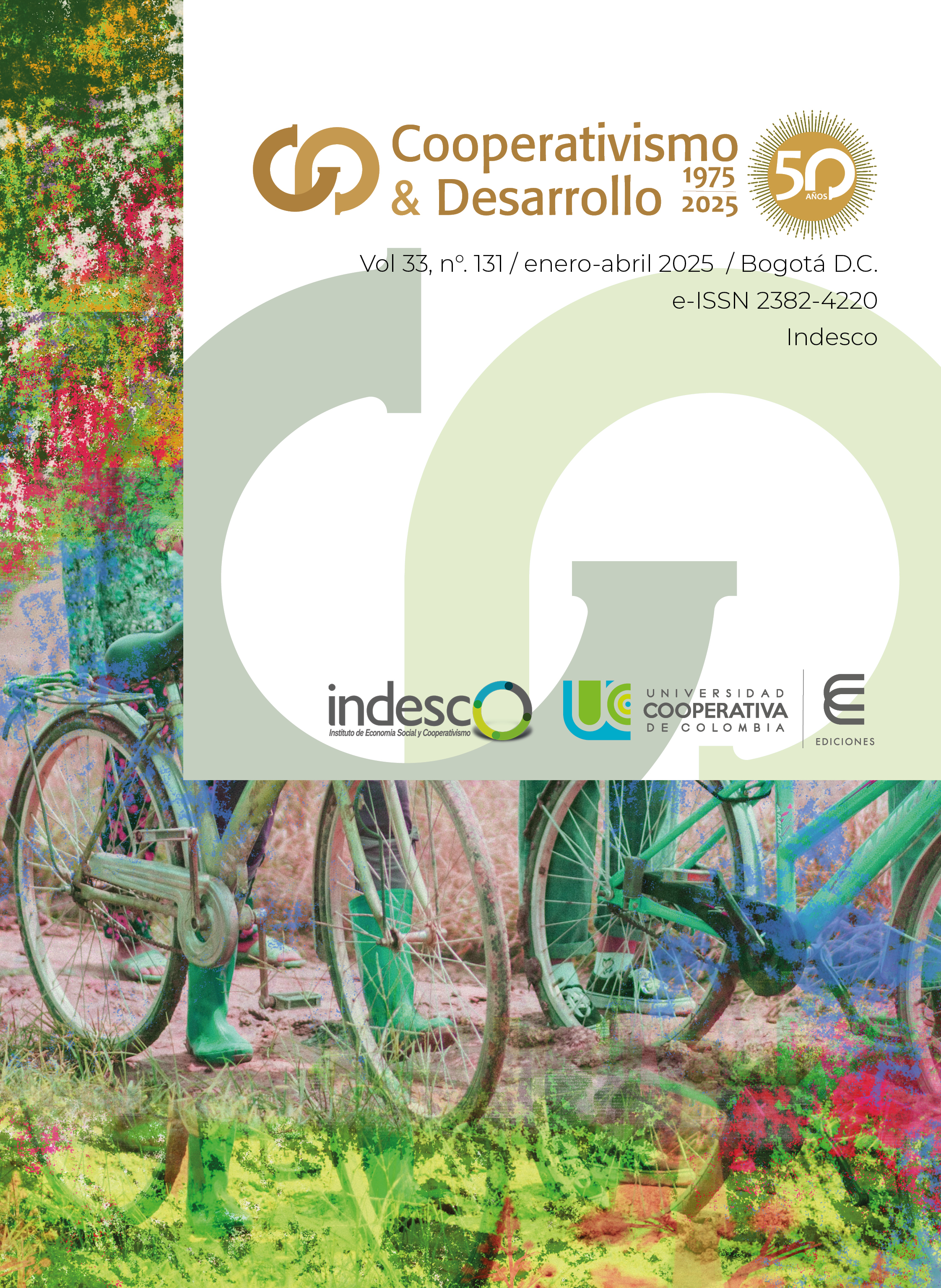
Cooperativism as a strategy for territorial development in La Plata, Huila (Colombia)
This article analyzes the role of coffee cooperatives as a territorial development strategy in La Plata, Huila (Colombia), through a case study of Global Cafés. Based on the premise that rural cooperatives not only facilitate coffee marketing but also generate social, economic, and organizational transformations in their territories, it investigates how this organization has contributed to the resilience of small producers. Using a qualitative approach and the case study method, information was collected through semi-structured interviews with members of the cooperative. The results show that, in addition to offering stable prices and better sales conditions, Global Cafés provides revolving loans, advances for coffee orders, access to inputs, and a solidarity fund, thereby strengthening economic autonomy and social cohesion. Challenges such as the lack of its own headquarters, limitations in certifications, and low youth participation were also identified. It is concluded that cooperativism, when rooted in the local social fabric, acts as an agent of territorial transformation, promoting equity, sustainability, and endogenous development.
How to Cite
License
Copyright (c) 2025 Cooperativismo & Desarrollo

This work is licensed under a Creative Commons Attribution 4.0 International License.
As the author of the article declares that is an original unpublished work exclusively created by me, that it has not been submitted for simultaneous evaluation by another publication and that there is no impediment of any kind for concession of the rights provided for in this contract.
In this sense, I am committed to await the result of the evaluation by the journal Cooperativismo & Desarrollo before considering its submission to another medium; in case the response by that publication is positive, additionally, I am committed to respond for any action involving claims, plagiarism or any other kind of claim that could be made by third parties.
At the same time, as the author or co-author, I declare that I am completely in agreement with the conditions presented in this work and that I cede all patrimonial rights, in other words, regarding reproduction, public communication, distribution, dissemination, transformation, making it available and all forms of exploitation of the work using any medium or procedure, during the term of the legal protection of the work and in every country in the world, to the Universidad Cooperativa de Colombia Press.
Agudelo Montes, M., & López Cabal, A. T. (2018). Simulador del costo de producción de café luego de una agregación de valor: Estudio de caso empresa cooperativa de caficultores del centro del Valle – Caficentro (Tesis de maestría, Universidad Tecnológica de Pereira). Repositorio Institucional UTP. https://repositorio.utp.edu.co/handle/11059/3476
Alianza Cooperativa Internacional. (1995). Declaración sobre la identidad cooperativa. ACI.
Alianza Cooperativa Internacional. (2024). ¿Qué es una cooperativa? https://ica.coop/es/cooperativas/que-es-una-cooperativa
Arboleda, O. L., Zabala, H. E., & Cueto, E. N. (2020). El cooperativismo caficultor en Colombia: El caso de la Cooperativa de Caficultores de Andes en el Departamento de Antioquia, 1927–2015. América Latina en la Historia Económica, 27(1), 1–30. https://doi.org/10.18542/alhe.v27i1.9422 DOI: https://doi.org/10.18232/alhe.1025
Carazo, P. C. M. (2006). El método de estudio de caso: Estrategia metodológica de la investigación científica. Pensamiento & Gestión, (20), 165–193.
Coque, J. (2002). Las cooperativas en América Latina: Visión histórica general y comentario de algunos países tipo. CIRIEC-España, Revista de Economía Pública, Social y Cooperativa, (43), 5–37.
Falcón Pérez, C. E., & Fuentes Perdomo, J. (2019). Mejorando el bienestar de la sociedad a través del cooperativismo de plataforma. CIRIEC-España, Revista de Economía Pública, Social y Cooperativa, (97), 161–184. https://doi.org/10.4471/ciriec.2019.187 DOI: https://doi.org/10.7203/CIRIEC-E.95.12655
Farias, C. M., & Gil, M. F. (2013). Cooperativismo. Instituto Federal de Educação, Ciência e Tecnologia.
Fernández, M. E. (2006). Las cooperativas: Organizaciones de la economía social e instrumentos de participación ciudadana. Revista de Ciencias Sociales (VE), 12(2), 237–253. DOI: https://doi.org/10.31876/rcs.v12i2.25323
Food and Agriculture Organization of the United Nations. (2012). Las cooperativas en el servicio del desarrollo rural sostenible. FAO.
Mendoza Ayaviri, R., Pacheco Choque, R., & Tarqui Cátacora, W. (2000). Perspectivas en el comercio internacional de las organizaciones de pequeños productores de café: Estudio de caso Cooperativa Agrícola Villa Oriente (Trabajo dirigido, Universidad Mayor de San Andrés). Repositorio Institucional UMSA. https://repositorio.umsa.bo/
Mogrovejo, R., Mora, A., & Vanhuysegem, P. (2012). El cooperativismo en América Latina: Una diversidad de contribuciones al desarrollo sostenible. Oficina de la OIT para los Países Andinos.
Progreso Foundation. (2024). Catálogo de cooperativas cafetaleras – Global Cafés. https://progreso-foundation.org/wp-content/uploads/2024/02/Cat%C3%A1logo-Global-Caf%C3%A9s-Progreso.pdf
Wilson, A., Hoyt, A., Roelants, B., & Kumar, S. (2021). Analicemos nuestra identidad cooperativa [Documento de debate para el 33.º Congreso Cooperativo Mundial]. Alianza Cooperativa Internacional. https://cdn.coop/33rd-Congress-Debate-Paper-Spanish.pdf